
By Dr Edmond Edi-Osagie MB.BS, MRCOG, MD, Consultant Gynaecologist
Finding out you have an ovarian cyst is unsettling, and the word carries more weight than it usually deserves. So the reassuring fact comes first: most ovarian cysts are harmless, most cause no symptoms, and most disappear on their own within a few menstrual cycles. The job of a specialist is not to treat every cyst but to work out, calmly and accurately, which of the small minority need attention.
This guide explains how we tell the different types apart, which symptoms warrant a scan, what the scan shows, and when removal is the right choice. It is written to inform rather than alarm.
What an ovarian cyst is
An ovarian cyst is a fluid-filled sac that develops on or inside an ovary. The ovaries make a cyst-like structure every month as part of the normal cycle: a follicle grows, releases an egg, and then collapses into a corpus luteum that produces progesterone. When that process stalls, the follicle or the corpus luteum can persist and enlarge. Cysts that form this way are called functional cysts. They are by far the most common type, which is why cysts are so frequent in women who are still having periods, and most resolve within two or three cycles.
Non-functional cysts arise from the tissues of the ovary itself rather than from the ovulation cycle, so they do not come and go with the calendar. Some sit quietly for years, others grow slowly, and a small number need to be removed. Working out which category a cyst belongs to is the first step, and a good quality ultrasound scan usually settles it.
Any cyst found after the menopause is given a slightly more careful look, which is routine rather than a cause for concern.
The main types
Ovarian cysts fall into a handful of groups, and the group matters more than the size when it comes to deciding what, if anything, needs doing.
Functional cysts
Follicular cysts form when a follicle fails to release its egg and keeps filling with fluid. Corpus luteum cysts form after ovulation, when the collapsed follicle seals over and fills with fluid or blood. A corpus luteum cyst that bleeds into itself is known as a haemorrhagic cyst, and although it can be painful, it almost always settles by itself.
Dermoid cysts
Known medically as mature cystic teratomas, these develop from the cells that make eggs and can contain tissue such as hair, skin and fat. They are most often found in younger women, grow slowly and do not resolve on their own, so we usually recommend removal once they reach a moderate size.
Cystadenomas
These develop from the cells on the surface of the ovary and are filled with watery or mucus-like fluid. They are benign but can grow large, and removal is usually advised once they are sizeable or growing.
Endometriomas
Sometimes called chocolate cysts, these form when endometriosis tissue implants on the ovary and bleeds with each cycle, filling the cyst with old blood. An endometrioma is a sign of endometriosis elsewhere in the pelvis, so it is best managed as part of a complete assessment of endometriosis and pelvic pain rather than in isolation, and it matters particularly if you are planning a pregnancy.
Symptoms, and the ones that need urgent attention
Many cysts cause no symptoms and are found by chance on a scan for something else. When symptoms do occur, the common ones are:
- A dull ache or a feeling of pressure on one side of the lower abdomen
- Bloating
- Pain during sex
- Discomfort when opening the bowels or passing urine
- Changes to the pattern of your periods
None of these is specific to ovarian cysts, which is why a scan is more useful than guesswork.
Sudden, severe, one-sided pain
A small number of situations need urgent attention. If a cyst twists the ovary on its blood supply, called torsion, or bursts, called rupture, the pain is typically sudden, severe and one-sided, and it may come with nausea, vomiting, faintness or fever.
This is an emergency. Do not wait for a routine appointment: call 999 or go to your nearest accident and emergency department.
Persistent symptoms deserve a proper look
Because September is Gynaecological Cancer Awareness Month, it is worth being clear about one more thing. The great majority of ovarian cysts are benign, and the purpose of assessment is to confirm that. Even so, symptoms that are persistent rather than occasional deserve a proper look, particularly in women over 50:
- Bloating that does not go away
- Feeling full quickly
- Pelvic or abdominal pain
- Needing to pass urine more often or more urgently
If you have symptoms like these on most days for three weeks or more, see your GP or arrange an assessment rather than waiting to see whether they settle.
How cysts are assessed
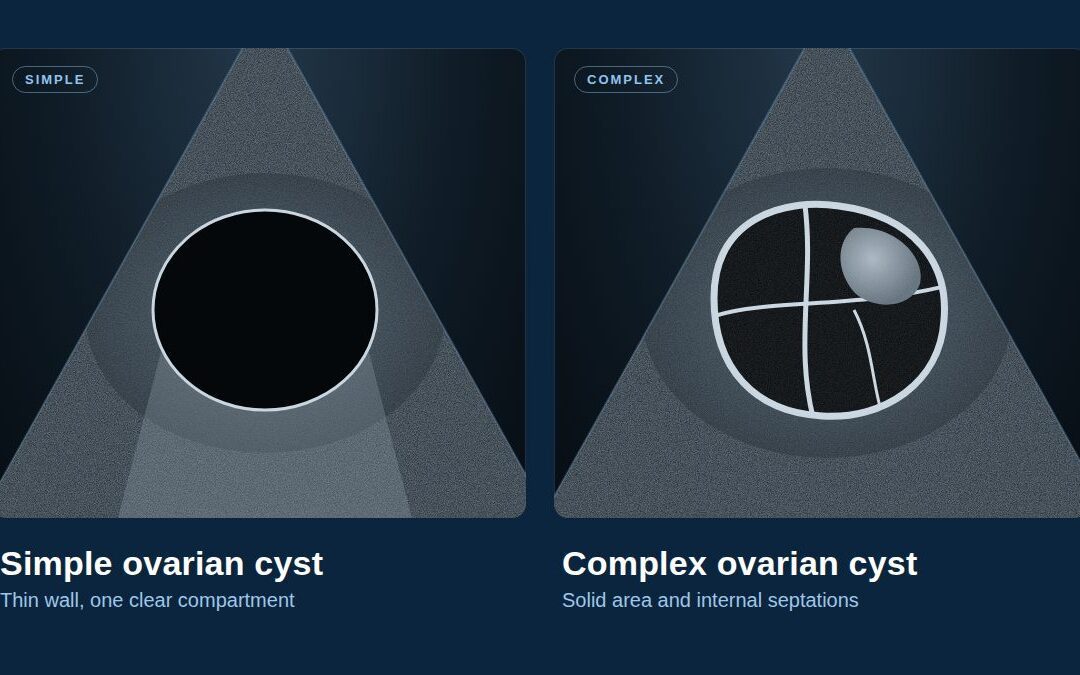
Transvaginal ultrasound is the cornerstone. It shows the size of the cyst, whether one ovary or both are affected and, most importantly, what the cyst looks like.
- Thin walls
- A single compartment
- Clear fluid inside
- Almost always benign
- Solid areas
- Thick internal walls
- Several compartments
- An irregular outline
A simple cyst has thin walls, a single compartment and clear fluid inside, and is almost always benign. A complex ovarian cyst has features such as solid areas, thick internal walls, several compartments or an irregular outline. Complex does not mean cancerous. Dermoids, endometriomas and haemorrhagic cysts all look complex on ultrasound and all are benign. It means the cyst needs a more considered assessment.
The CA125 blood test
CA125 is a blood test that is often mentioned and often misunderstood. It measures a protein that can be raised by ovarian cancer, but it is also raised by endometriosis, fibroids, pelvic infection, pregnancy and even a normal period. Before the menopause a raised CA125 far more often points to a benign cause, and for a simple cyst the test adds little. After the menopause it is more informative, and we combine it with the ultrasound findings to calculate a risk score that guides the plan.
On its own, a CA125 result means very little.
When an MRI helps
Where ultrasound leaves a question unanswered, an MRI scan gives a more detailed picture. It is particularly useful for distinguishing an endometrioma from other types and for planning surgery on larger or more complex cysts.
When treatment is needed and when it is not
For most cysts the right treatment is time. Before the menopause, the size of a simple cyst guides what happens next:
After the menopause the thresholds are lower and the follow-up more structured. A small simple cyst with a normal CA125 can be safely watched with repeat scans over a year and discharged if unchanged. A complex cyst, a raised risk score or a cyst causing symptoms usually leads to a recommendation for removal.
Three things change the plan regardless of size
- Symptoms that are affecting your life
- A cyst that looks complex on ultrasound and cannot be confidently explained
- A cyst that has grown between scans
None of these means anything is seriously wrong. They simply tip the balance from watching to acting, and we would rather explain the reasoning than hand you a rule.
Ovarian cyst removal and preserving ovarian reserve
When removal is advised, it is almost always by keyhole surgery. A laparoscopic ovarian cystectomy removes the cyst through three or four small incisions while leaving the ovary in place. Most patients go home the same day and are back to normal activity within about two weeks. We have described what a laparoscopy involves in a separate guide.
The part that matters most, and varies most between surgeons, is what happens to the ovary itself. Every ovary holds a finite store of eggs, its ovarian reserve, and the tissue around a cyst is often perfectly healthy.
Careful surgery means separating the cyst wall from the ovary cleanly, controlling bleeding without cauterising healthy tissue, and conserving as much of the ovary as possible. This matters most with endometriomas, where the cyst wall is closely bound to ovarian tissue, and for anyone who may want to conceive.
We take conservation of healthy ovarian tissue seriously in every case, and where fertility is a priority we discuss the timing of surgery and any fertility preservation options before proceeding.
Removing the whole ovary is occasionally the right decision, for example with certain cysts after the menopause, but it should be a choice made with you rather than a default.
Specialist assessment in Manchester and Cheshire
Dr Edmond Edi-Osagie is a senior consultant gynaecologist with a particular interest in ovarian cysts, endometriosis and fertility, and an accredited RCOG preceptor in advanced laparoscopic surgery. We manage all types and sizes of ovarian cyst, from those that need nothing more than a reassuring scan to complex cysts, dermoids and endometriomas that call for expert surgery. Consultations take place in Manchester city centre and at The Alexandra Hospital in Cheadle, and you can refer yourself without a GP letter.
An initial consultation includes a full history, an examination where appropriate, and a pelvic ultrasound arranged promptly, so the appointment answers your question rather than starting a queue. If you are planning a pregnancy, we can assess your ovarian reserve and discuss pre-conception planning alongside the cyst itself. To arrange an assessment, contact us or call 0161 244 8623.
Frequently asked questions
Can an ovarian cyst affect fertility?
Most do not. Functional cysts are part of the ovulation cycle and have no lasting effect. Endometriomas are the exception, because both the cyst and surgery to remove it can reduce ovarian reserve, so the decision to operate weighs your fertility plans carefully. If you are trying to conceive, say so at your first appointment.
How big does a cyst need to be before it is removed?
There is no single number. Simple cysts under five centimetres are usually left to resolve, and removal is discussed once a cyst is over seven centimetres or growing. Appearance and symptoms matter more than size: a small complex cyst may need more attention than a large simple one.
Are ovarian cysts a sign of cancer?
The vast majority are benign, particularly before the menopause. Ultrasound appearance, age and, where relevant, blood tests identify the small number that need further investigation. A cyst on its own is not a reason to fear the worst.
Can cysts come back after removal?
A removed cyst does not return, but new ones can form. Functional cysts may recur from time to time as part of the normal cycle. Endometriomas can recur if the underlying endometriosis is not managed, and hormonal treatment after surgery reduces that risk.
This article is for information and does not replace individual clinical advice. If you have symptoms that concern you, arrange an assessment.